Meituan's LongCat-2.5 is a 1.6-trillion-parameter multimodal model built for long-horizon coding agents
- Notes
- Meituan
- LongCat
- AI agents
- Coding
- Written by
- Bhargav Tibadiya
- Published
- Reading time
- 6 min read
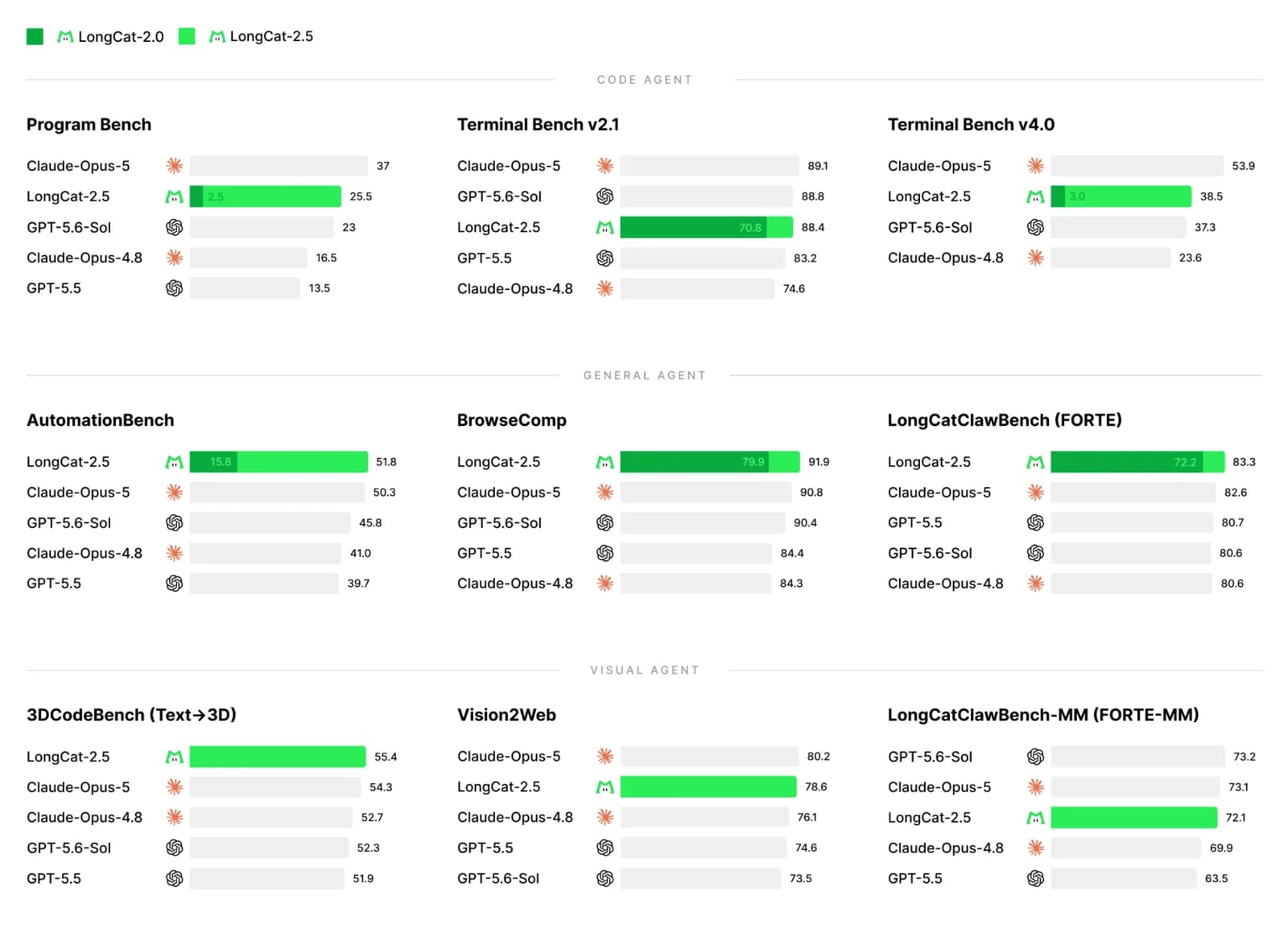
Meituan released LongCat-2.5 on November 1, 2026: a 1.6-trillion-parameter mixture-of-experts model with about 48 billion parameters active per token, built natively multimodal and trained specifically for long-horizon agentic tasks like full-project coding. On Meituan's own benchmarks it lands between Claude Opus 4.8 and Claude Opus 5 on most coding evaluations and beats everything it was compared against on web browsing and text-to-3D work. The model is not open weights yet, but the API is live at $0.30 per million input tokens and $1.20 per million output, with an Anthropic-compatible endpoint you can point Claude Code at today. Just as notable: it was trained and is served on domestic Chinese accelerators, with a custom 4-bit inference stack.
What LongCat-2.5 is
LongCat-2.5 is the third generation of Meituan's LongCat line, and the first with native visual understanding. Instead of bolting a vision encoder onto a language model, it converts visual signals into multi-level discrete tokens, using residual vector quantization over native-resolution image features, so the backbone reads images and text in one token format. Because a fixed tokenizer produces those visual tokens, they can be precomputed and cached offline, which simplifies long-sequence training and load balancing. Meituan says the design delivers strong visual coding alongside creative design and 3D generation tasks.
The agentic side is where most of the training effort went. Meituan folded more long-horizon trajectories into long-sequence training and ran large-scale reinforcement learning on end-to-end engineering work: complex codebase development and full-project builds. Real failure trajectories from agents in the wild get converted into reproducible, verifiable training tasks, so the model keeps getting targeted data for the exact places it falls over.
How Meituan trained it
The RL pipeline is the interesting engineering story:
- Training tasks come from real GitHub pull requests and their linked issues. Agents annotate tasks and synthesize interactive environments, validated with fail-to-pass and pass-to-pass tests, and live rollout pass rates feed back into re-labeling.
- Rollouts are asynchronous and partial: in-flight trajectories get interrupted, saved and resumed, with gradient corrections that bound the bias from stale checkpoints.
- Anti-reward-hacking is built in: task environments have no network access, git history and cached files are removed, an LLM judge audits trajectories for exploits, and extra penalties suppress repetitive reasoning.
- Training is mixed across different harnesses and task families, which Meituan credits for the model generalizing to scaffolds it was not trained on.
Specialized skills from LongCat-2.0's expert groups, covering multi-turn execution, single-turn reasoning, instruction following and safety, are distilled back into the main model through a multi-teacher process.
LongCat-2.5 benchmarks, with honest caveats
Meituan's dashboard compares LongCat-2.5 against GPT-5.5, GPT-5.6 Sol, Claude Opus 4.8 and Claude Opus 5, plus GLM-5.3, Kimi K3 and DeepSeek V4.1 Flash in the full table. The headline numbers:
- Terminal Bench v2.1: 88.4, essentially tied with Claude Opus 5's 89.1 and behind DeepSeek V4.1 Flash's 90.6, and up from LongCat-2.0's 70.8.
- Terminal Bench v4.0, the harder set: 38.5, behind Claude Opus 5's 53.9 and GLM-5.3's 41.8, but up from LongCat-2.0's 3.0.
- BrowseComp web browsing: 91.9, the best score in the table.
- JobBench professional work: 65.4, a point and a half behind Claude Opus 5's 66.7.
- 3DCodeBench text-to-3D: 55.4, again the best in the comparison.
- HLE with tools: 63.1, behind Opus 5's 64.7 and DeepSeek V4.1 Flash's 63.9.
Two caveats before you read too much into any of it. First, these are vendor-run numbers: scores marked with an asterisk come from public reports and leaderboards, and the comparison set stops at Opus 5, while the current Opus alias in Claude Code resolves to 5.5. Second, the pattern is consistent with what SemiAnalysis found in its GDPx benchmark: everyone is still bad at long-horizon professional work, and the spread between models matters less than the absolute level.
Trained and served on domestic chips
The infrastructure section is geopolitically significant. LongCat-2.5 was trained on domestic AI accelerators with under 80 GB of memory each, using supernode-aware parallelism that keeps parameter gathering and expert routing inside the high-bandwidth interconnect, plus a dual-shard FSDP setup that Meituan says delivers 86 percent higher per-device throughput than the DDP baseline in long-sequence fine-tuning.
Inference runs at W4A4, with both expert weights and activations quantized to 4 bits on native INT4 units. Against a W8A8 baseline, Meituan reports 43 percent higher prefill throughput, 43 percent higher decode throughput, and roughly 16 to 20 percent lower time-to-first-token and per-token latency, with accuracy comparable to the unquantized model on its evaluated tasks. Training and inference are kept bitwise consistent, which is what makes large-scale agentic RL practical at this size.
How to try LongCat-2.5
The API is live at $0.30 per million input tokens and $1.20 per million output tokens, with a 1M-token context window and an Anthropic-compatible endpoint at api.longcat.chat. Meituan publishes a Claude Code guide, but follow it blindly and you hit two traps, as a dev.to walkthrough by Gabriel Anhaia documents: Claude Code does not recognize the LongCat-2.5 model ID, assumes a 200K context window and auto-compacts there (the fix is setting CLAUDE_CODE_MAX_CONTEXT_TOKENS), and the guide writes to your global settings file, which reroutes every Claude Code session on the machine. A wrapper script scoped to one launch avoids both.
On weights: not yet. TechNode reports GitHub and Hugging Face releases are planned to follow with no date. The predecessor's weights did ship: LongCat-2.0 is on Hugging Face under the MIT license at the same 1.6T total and 48B active parameter counts, so there is reason to expect 2.5 to follow.
What LongCat-2.5 means
The practical read: this is the strongest model out of China this cycle for agentic coding, priced like a commodity at $0.30 per million input tokens. That continues the pressure the DeepSeek open-source harness release started, and it arrives in the same week that GPT-6.1 Terra made computer-use agents cheap enough for everyday automation. The pattern across all three: agentic capability is commoditizing faster than the frontier labs' pricing reflects, and routing cheap traffic to models like this while escalating hard cases is becoming the default architecture.
The strategic read is the chips. A 1.6-trillion-parameter model trained end-to-end on domestic accelerators, with the inference stack co-designed for the same hardware, is the clearest sign yet that export controls have not closed the frontier gap. They have rerouted it.
FAQ
What is LongCat-2.5?
LongCat-2.5 is Meituan's 1.6-trillion-parameter mixture-of-experts model with about 48 billion active parameters per token, released November 1, 2026. It is natively multimodal, reading images as discrete tokens in the same format as text, and trained for long-horizon agentic tasks like full-project coding.
Is LongCat-2.5 open source?
Not yet. No weights have been released. TechNode reports GitHub and Hugging Face releases are planned, and the predecessor LongCat-2.0 shipped weights under the MIT license, so an open release is plausible but unconfirmed.
How much does the LongCat-2.5 API cost?
$0.30 per million input tokens and $1.20 per million output tokens, with a 1M-token context window. That is a fraction of frontier-model pricing.
How does LongCat-2.5 compare to Claude Opus 5?
On Meituan's own benchmarks it essentially ties Opus 5 on Terminal Bench v2.1 (88.4 vs 89.1) and JobBench (65.4 vs 66.7), beats every compared model on BrowseComp and 3DCodeBench, and trails Opus 5 clearly on the harder Terminal Bench v4.0 (38.5 vs 53.9). The numbers are vendor-run, so treat them as indicative.
Can I use LongCat-2.5 in Claude Code?
Yes, through Meituan's Anthropic-compatible endpoint. Set ANTHROPIC_BASE_URL to the LongCat endpoint and the model variables to LongCat-2.5. Two gotchas: set CLAUDE_CODE_MAX_CONTEXT_TOKENS or Claude Code compacts at an assumed 200K window, and use a wrapper script rather than the global settings file so your other sessions stay on Claude.
Sources
- Announcement and benchmarks: Introducing LongCat-2.5 - Meituan (opens in a new tab)
- Claude Code setup and pricing: Meituan's LongCat-2.5 drops into Claude Code at $0.30/$1.20 - dev.to (opens in a new tab)
- Coverage: Meituan launches LongCat-2.5 multimodal AI model for extended coding tasks - TechNode (opens in a new tab)
Elsewhere on this site
The selected work catalogue lists the SaaS products and dashboards behind notes like this one.




