AI agents vs workflows: what should you build for 2027?
- AI Agents
- Guides
- AI agents
- Automation
- Architecture
- Written by
- Bhargav Tibadiya
- Published
- Reading time
- 17 min read
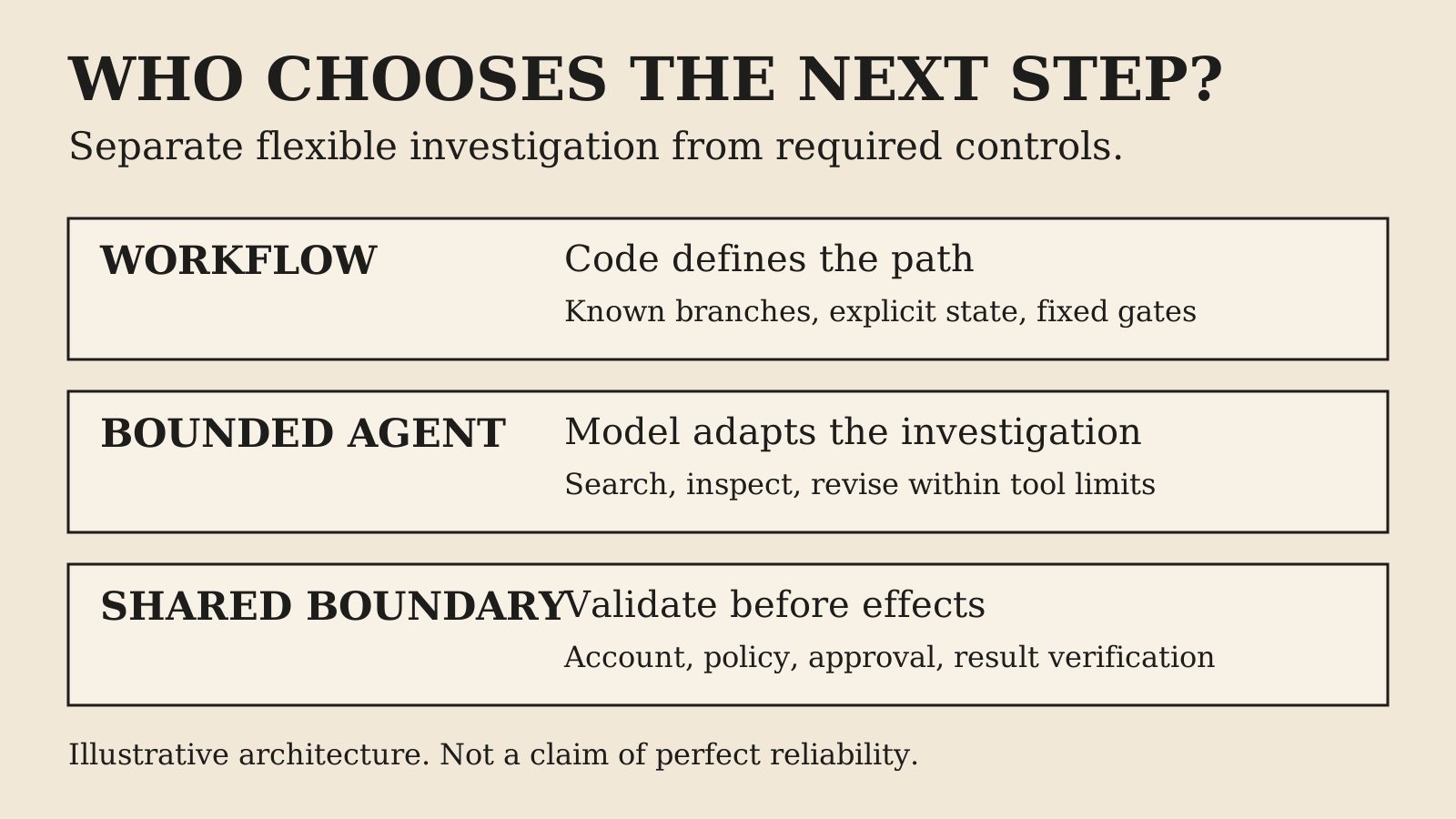
Use a workflow when you can define the required sequence and conditions in advance. Use an AI agent when the next useful step depends on interpreting information that arrives during the task. For many products, the right answer is a hybrid: code controls state, permissions and consequential actions, while a model handles a bounded step that needs judgment.
That is the practical difference between AI agents and workflows. It is also a better starting point for a 2027 build than choosing a framework because its demo looks autonomous. This guide uses documentation checked on November 5, 2026. The examples are proposed designs, not reports of measured deployments, and the future-year title does not predict unreleased capabilities.
AI agents vs workflows: who chooses the next step?
The core distinction is architectural: in a workflow, models and tools follow predefined code paths; in an agent, models dynamically direct the process and tool use12. Both can use language models, retrieve documents and call APIs.
A workflow can classify a support request with a model, validate the returned category, retrieve a policy and prepare a response. It remains a workflow if the surrounding program decides that those steps happen in that order. Adding an LLM does not automatically make the whole process an autonomous agent.
An agent might inspect the request, discover missing information, choose a search, read the result and decide which source to inspect next. The path depends on observations during the run. That flexibility is useful when the problem cannot be reduced to a small set of known routes without losing important cases.
The boundary is not always clean in product marketing. IBM's agentic workflow label covers structured orchestration that can include tools, agents and human activities3, and Microsoft's agent framework spans a spectrum from model-led decisions to deterministic executors4. Define the control flow in your design document rather than relying on a label everyone interprets differently.
Start with the smallest system that can pass the test
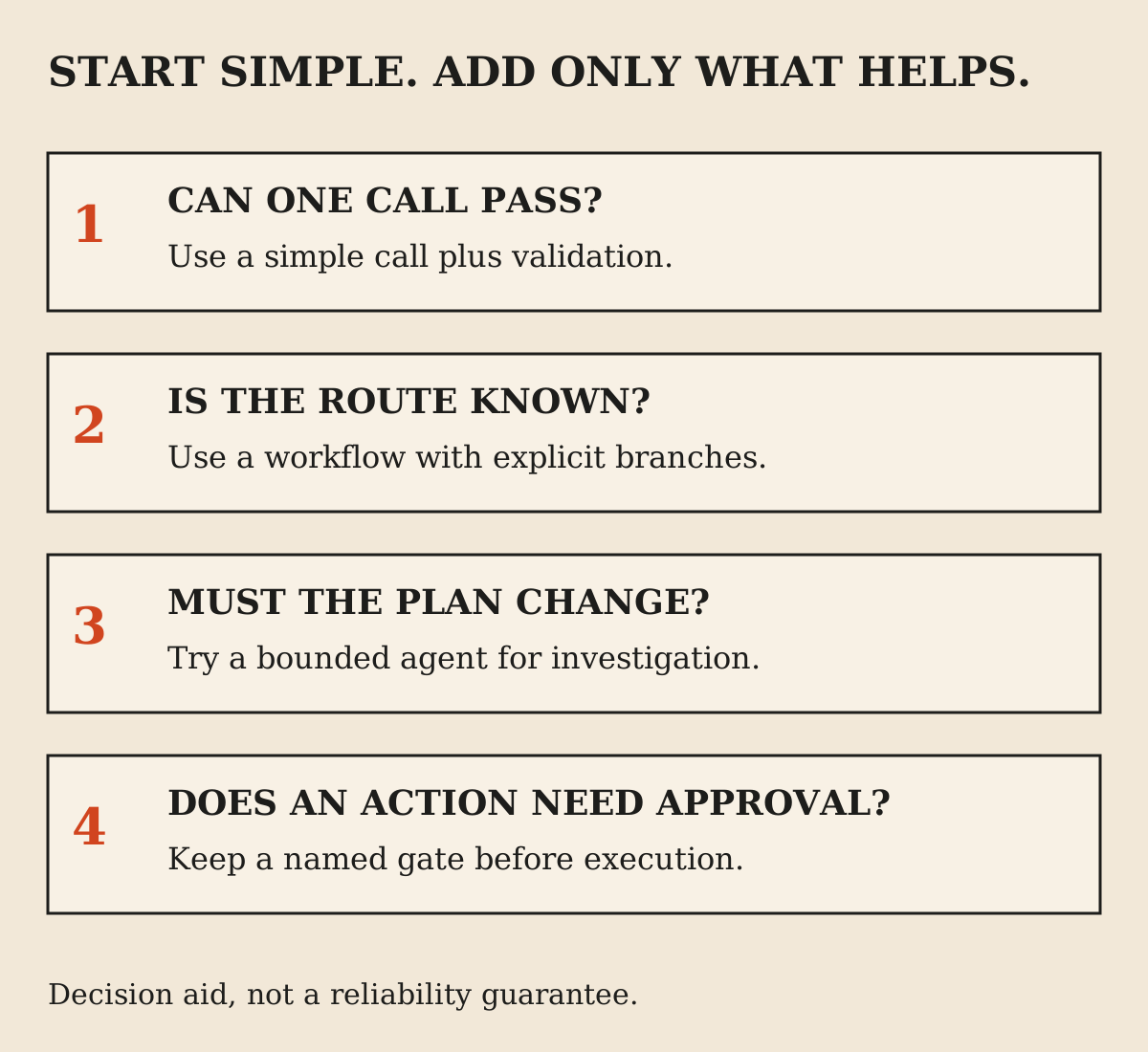
Before choosing either approach, ask whether a single model call with the right evidence is enough. A request to extract three fields from an invoice may not need planning, tool discovery or a loop. A traditional parser may be better still if the input is already structured.
Start with the simplest solution and add complexity only when it improves outcomes1. Anthropic's article now carries a note that the tooling landscape has changed since publication, so treat its patterns as conceptual guidance rather than a current framework inventory1. The underlying question remains useful: what does the additional autonomy buy?
Write a minimal success test before building the larger system. If one prompt plus validation meets the quality and latency requirements on representative inputs, an agent loop needs another reason to exist. Possible reasons include necessary follow-up searches, variable decomposition or recovery that cannot be covered by a small, explicit workflow.
Complexity has recurring costs. More moving parts mean more state to inspect, more failure paths and more ways for a product update to change behavior. Do not count only the prototype effort. Count the work of explaining a failure to a customer and proving that the repair does not break an earlier case.
When a workflow is the better choice
Choose a workflow when required steps are known, business rules are explicit and ordering matters. Examples include validating a submitted form, checking an account's eligibility, generating a draft from approved facts and routing it to the correct reviewer.
This does not mean every output is deterministic. A summarization step can vary while the required approval order remains fixed. Separate variation in content from variation in control flow. You may tolerate two good phrasings of a summary while refusing any variation in who is allowed to approve a payment.
Known branches belong in explicit logic where possible. If a customer region determines which tax rule applies, write that branch from the approved rule source. Asking a model to remember the rule from a long prompt makes a simple requirement harder to verify. A model can help interpret an ambiguous address, but the final region-to-rule mapping should not become creative.
A workflow is also a strong default when the task must pause and resume. A person may take a day to approve a draft. An external service may complete a job later. Persist the state and the awaited condition instead of assuming a conversation window will remain an accurate task database.
When an agent earns its flexibility
An agent is a stronger candidate when useful next steps cannot be enumerated cheaply in advance. Open-ended research is a common example: one source reveals a contradiction, which creates a new question, which changes the search. Repository debugging can have the same shape because the relevant files and tests depend on what the investigation finds.
The important phrase is earns its flexibility. Variable input alone is not sufficient. A form with free-text comments may still lead to one of four known actions. Use a model for classification if needed, then let the workflow enforce the finite routes.
Agents are more justified when the uncertainty concerns the path to the answer, not the authority to act. A model may choose which document to inspect next. That does not mean it should decide whether a customer qualifies for an exception to a financial policy or whether a private file may be disclosed.
Define the permitted search space. Which sources, tools and accounts may it use? How much time and money can it spend? What evidence is enough to stop? An agent without those boundaries is not a complete product specification. It is an invitation to discover the limits during an incident.
The hybrid pattern: fixed structure, flexible investigation
A hybrid places a model-led investigation inside a process whose important boundaries remain explicit. The surrounding workflow owns the request, identity, state and final action. The agent produces evidence or a candidate result. The workflow validates that result and decides whether it can proceed or needs review.
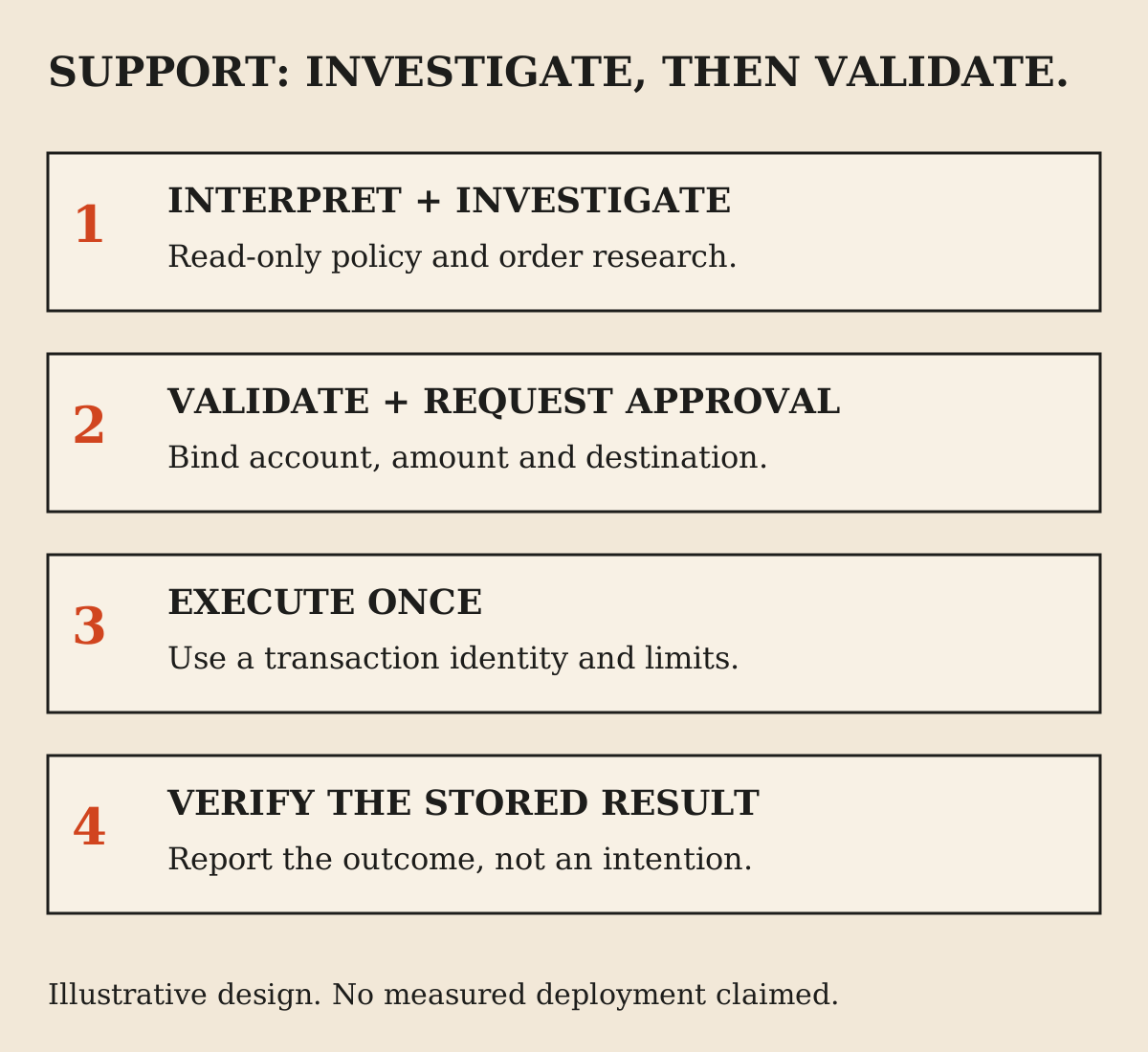
Consider a support case. The agent can search approved help material and explain which policy appears relevant. A separate check can verify the customer's order, the applicable policy version and whether a refund is within a recorded approval. The agent's explanation is useful context, but it is not a substitute for the transaction checks.
A graph controls the structure while individual executors can use agents where reasoning helps4; IBM draws the same line between interpretation and mandatory business rules3. These are vendor-specific implementations of a broader design principle, not proof that their frameworks eliminate mistakes.
The unit of design should be the step. Ask who should decide this particular thing: code, a model or a person? A project does not need one answer for every step. Keeping judgment local often makes the product easier to test and explain without giving up the useful part of AI.
Worked example: support triage without autonomous refunds
Imagine a support inbox for a small subscription product. Customers write in ordinary language about login problems, billing questions, cancellation and missing features. The proposed system should prepare useful replies and route cases. This is an illustrative design, not a claim about a live service.
Begin with a workflow that reads the message, resolves the customer account, classifies the request and retrieves the relevant policy. The classifier can be a model, but its output must match a limited schema. If the account cannot be resolved or the category is uncertain, route the case to a person instead of guessing.
For a common login issue, the workflow can prepare a standard response from approved steps. For a complex billing complaint, a bounded agent might inspect the order history and relevant policy documents to explain the discrepancy. Its tools should be read-only during that investigation.
A refund is a separate transition. The system must establish the correct order, amount, policy and authorization before sending money. If the proposed amount or exception needs review, create an approval task containing the facts the reviewer needs. Do not let a persuasive customer message or a model's sympathetic explanation become approval.
After approval, execute the transaction with an idempotency key and record the provider's result. Then verify the resulting refund record before telling the customer it succeeded. If the response is uncertain, investigate the existing transaction before retrying. A duplicate refund is not fixed by explaining that the network timed out.
This design uses AI where language and evidence are messy, then uses ordinary software controls at the consequential boundary. It is less theatrical than an agent that does everything, but its success and failure states are much easier to inspect.
Worked example: research that actually needs a changing plan
Now consider a request to compare three vendors against a set of technical requirements. The relevant information may be spread across pricing, documentation, security pages and support answers. One vendor may use a different term for the required feature. Another may publish conflicting limits.
A rigid fetch-three-pages workflow will miss some of that uncertainty. A bounded research agent can choose follow-up searches, inspect primary documentation and record contradictions. Its next step should depend on the evidence, not on a fixed number of searches that looks complete in a progress log.
The surrounding workflow still matters. It should preserve the original requirements, allowed sources, budget and output format. It should require a source for each material claim and distinguish unavailable evidence from a negative finding. Not finding a policy is not proof that the vendor lacks one.
Stop when the decision criteria are supported or the remaining gaps require another person. Endless searching is not depth. A useful result can say that two options qualify and the third remains unverified because its public documentation does not answer a specific requirement.
If the next step is contacting a vendor, buying a plan or sharing internal requirements, treat that as a new effect with its own permission and disclosure checks. The research agent's ability to find an email address does not authorize an outreach campaign.
Approval belongs at a state transition
Human approval is often added as a vague instruction: ask before doing anything risky. That leaves too much to interpretation. Define exactly which transition requires approval, what the person sees and what changes invalidate the approval.
For example, approval to send one quoted price to one recipient should bind the amount, currency, recipient and relevant attachment version. If any of those changes, the previous approval may no longer cover the action. A generic approved flag detached from the proposed payload is weak evidence.
The approval interface should show the decision, not dump a long transcript on the reviewer. Include the proposed action, its destination, the important facts, cost or consequence, and the unresolved uncertainty. A reviewer cannot meaningfully approve a result they cannot inspect.
After approval, recheck time-sensitive facts at the final boundary. Inventory, recipient permissions and account state can change while a task waits. The review is necessary, but it does not make yesterday's external state current. Persist both the approval and the final execution evidence.
Tools need narrow contracts and reliable failures
A tool interface is part of the product's safety and correctness, not a detail to leave until after prompting. Give tools clear names, typed inputs, scoped permissions and outputs that distinguish success, failure and uncertainty.
A broad tool that can update any record with arbitrary fields is harder to reason about than a narrow operation that prepares one proposed change. Narrow tools make it easier to enforce invariants outside the model. They also produce clearer logs when something goes wrong.
Do not return a cheerful success message when only the request was accepted. If a background job is still running, return its identifier and state. If an email was drafted but not sent, say drafted. If a transaction's final status is unknown, say unknown and provide the record needed to check it.
External content must remain data. A retrieved document can contain useful facts and malicious instructions at the same time. A support ticket asking the assistant to bypass policy is not a policy update. A web page telling it to send private records elsewhere is not a tool instruction. Permission enforcement should not depend on the model politely ignoring every such attempt.
Keep credentials outside model-visible text where the platform permits. Limit each connection to the data and operations the task needs. A research task does not need a payment tool simply because the account has one available.
State, retries and idempotency are not optional extras
A task's state should survive a timeout, restart or delayed reply. Store what was requested, what has been established, what is waiting and which effects have already happened. The model's latest summary can help a person understand progress, but it should not be the only record of a transaction.
Retries need classification. Retrying a failed read is usually different from retrying a write whose response was lost. For the write, first inspect the target system or use the operation's idempotency mechanism. Otherwise the recovery path can be more damaging than the original error.
Define terminal states such as completed, needs input, blocked, timed out and cancelled. A task that cannot proceed should not remain silently running forever. A task awaiting a person should identify that person and the decision needed, without repeatedly creating the same approval request.
For long-running work, store checkpoints at meaningful boundaries. Resume from the last established state, not from a plan that assumes every earlier operation succeeded. The final report should match the external record, including partial completion and any cleanup still needed.
How to evaluate a workflow
A workflow gives you a known structure, so test its transitions directly. Check valid paths, invalid inputs, missing fields, service failures and timeouts. Verify that mandatory gates cannot be skipped by malformed data or an unexpected model response.
For a model step, validate both shape and meaning. JSON that parses can still contain the wrong customer category or an unsupported claim. Use deterministic checks for the parts that are exact, then a rubric or human review for judgments that cannot be expressed as a simple assertion.
Include duplicate delivery and out-of-order events in the test set. Real integrations retry webhooks and deliver updates late. The workflow should not send a second email or charge twice because the same event arrived again. These are ordinary distributed-system problems, even when the feature is marketed as AI.
A workflow is not automatically correct because it is explicit. Its code can encode the wrong policy, use stale data or omit an edge case. The advantage is that the path and its conditions can be inspected and tested. Reliability still requires the right requirements and implementation.
How to evaluate an agent
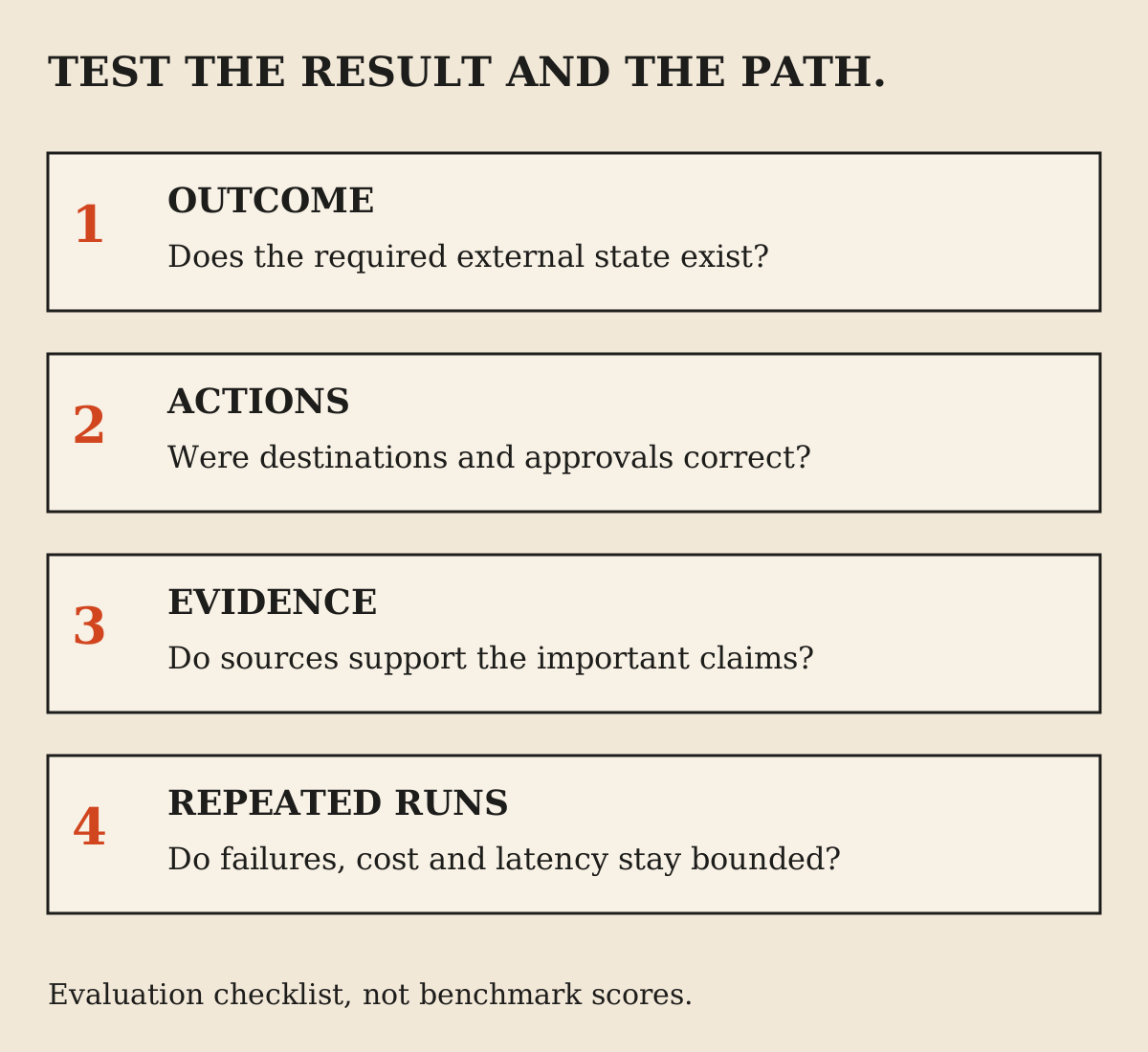
Agent evaluation needs to inspect the outcome and the path, not merely the final answer. Judge the resulting environment state, not the transcript: an agent saying a booking exists is not the same as a reservation appearing in the relevant system5.
Build representative tasks with explicit success criteria. Run multiple trials because the same request can produce different tool sequences. Keep the environment stable enough that you can tell whether a change in result came from the product or from changing test data.
Use several types of checks. Code can verify record values, required approvals, prohibited tool calls and resource limits. A model-based rubric can assess whether an explanation addresses the question. Human reviewers can calibrate that rubric and inspect important disagreements. No single grader should be assumed correct for every surface.
Check final state, actions, decisions and repeated-run reliability6. Arize sells evaluation tooling, so treat its guidance as practical vendor material rather than an independent guarantee. The useful point is to preserve the relationship between evidence, decision and action.
Track failures by type. Wrong retrieval, misunderstood intent, invalid arguments, tool error, unauthorized action and false completion need different fixes. A single average score can hide the failure class that makes the product unsuitable for a particular customer.
Measure cost per accepted outcome
Token cost is only one line in the budget. Include retrieval, external tools, execution time, retries, evaluation and human review. A cheaper model that needs repeated correction may cost more per accepted result than a more capable one used once.
Latency also depends on the path. Sequential searches and tool calls add time, while independent work may be parallelized. Do not promise a fixed response time from one model's token speed if the task normally waits on three external systems.
Use an illustrative budget before you have production data. Suppose a workflow makes three model calls, while an agent averages eight calls and sometimes reaches fifteen. That is not a claim about either approach in general. It is a planning scenario that tells you what to measure during the pilot.
Then replace the assumptions with actual distributions. Report typical and slow cases, not only the average. Measure the percentage of tasks accepted without correction, the time to recover failures and whether the system stays inside its budget. A task that produces an answer quickly but leaves a person doing the work is not cheap completion.
A staged rollout is better than a big autonomy switch
Begin with offline tests using representative, non-sensitive cases. Then run in a shadow mode where the system proposes an outcome without affecting customers. Compare its proposal with the real process and investigate disagreements.
Next, allow drafts or read-only assistance in a limited workflow. Make the user-visible status honest: prepared is not sent, and found is not verified. Give reviewers enough context to reject the proposal without reconstructing the entire run.
Only widen execution after the measured results justify it. Start with narrow, reversible operations whose final state can be checked. Maintain a rollback path and an owner for incidents. If the product cannot stop a running task or explain what it changed, it is not ready for broad autonomy.
For a 2027 roadmap, fund this operating work alongside model access. Evaluation, state, permissions and recovery are part of the feature. They are not a cleanup phase after the interesting agent demo has shipped.
When to redesign instead of adding another prompt rule
A failure can be a prompt problem, but repeated boundary failures often reveal a design problem. If the model keeps forgetting a mandatory approval, move the approval check into the execution path. If it repeatedly selects the wrong account, make account resolution explicit before exposing write operations.
If the system spends many turns searching for facts you already store in a database, improve retrieval or provide a narrow query tool. If it loops after a tool error, define the error and stop condition. If it cannot tell whether a write succeeded, improve the operation's status and idempotency contract.
Adding a second agent does not automatically create independent judgment. Both can share the same missing evidence or permission mistake. Use independent checks where the requirement is exact, and reserve additional model review for questions that benefit from another interpretation.
The AI coding agent comparison shows why capabilities need to be judged in the actual workflow rather than by a label. The assistant comparison applies the same acceptance-test thinking to personal subscriptions.
A practical architecture checklist
- Write the outcome in terms of an external record or usable artifact, not a generated answer alone.
- Identify which steps are fixed and which truly need a changing plan.
- Start with a simple call or workflow, then add a bounded agent only where the test requires it.
- Separate interpreting evidence from authority to change accounts, disclose information or spend.
- Define narrow tools, explicit state, retry rules and idempotency before enabling writes.
- Place approvals at named transitions and bind them to the actual proposed payload.
- Evaluate exact invariants with code and judgments with calibrated review.
- Measure accepted outcomes, correction time, failure recovery, cost and latency.
- Roll out through shadow mode, drafts and narrow execution before expanding autonomy.
- Keep an owner, a stop control and a recovery path for the deployed system.
The goal is not to eliminate agents. It is to spend flexibility where it helps and avoid paying for uncertainty where a rule would do. A modest system that finishes the job predictably is a better product than a broad one whose final state nobody can establish.
FAQ
What is the main difference between an AI agent and a workflow?
In a workflow, the surrounding program defines the path and conditions. In an agent, a model chooses useful next steps based on observations during the task. Both can use models and tools, so the presence of an LLM is not the deciding factor.
Does every AI application need an agent?
No. A single call, retrieval-assisted answer, traditional parser or fixed workflow may meet the requirement. Add an agent when a changing plan produces a measured benefit that simpler approaches do not provide.
Can a workflow include an AI agent?
Yes. A workflow can own the structure, state and approval gates while an agent handles a bounded investigation or judgment step. This hybrid avoids forcing one control style onto every part of the product.
Are workflows perfectly reliable?
No. They can encode wrong rules, miss edge cases or depend on failing services. Their advantage is explicit control flow that can be inspected and tested, not automatic correctness.
Where should human approval sit?
At a defined transition before an action that requires it, with the proposed payload, destination and consequences visible. Record the approval and recheck facts that may have changed while waiting.
Is a good final answer enough to evaluate an agent?
No. Check the actual resulting state, the actions taken, the evidence used and the behavior across repeated trials. A convincing answer can hide a failed or unauthorized operation.
Will a second agent make the first one safe?
Not automatically. Both may share the same unsupported assumption. Exact requirements such as approval, amount and destination should be enforced with appropriate checks outside a model-only conversation.
How should retries work after a timeout?
Distinguish reads from writes. Before retrying a write whose result is uncertain, inspect the target state or use an idempotency mechanism so recovery does not duplicate the effect.
Is this a prediction of 2027 agent capabilities?
No. It is architecture guidance based on documentation checked in November 2026. The decision process remains useful even as models and frameworks change.
Sources
- Anthropic: Building effective agents (opens in a new tab)
- Claude Academy: Workflows vs agents (opens in a new tab)
- IBM: Agent or agentic workflow decision guide (opens in a new tab)
- Microsoft: Workflows (opens in a new tab)
- Anthropic: Demystifying evals for AI agents (opens in a new tab)
- Arize: Agent evaluation (opens in a new tab)




