Let AI Draft, But Keep the Idea: What a New Writing Study Actually Found
- AI
- AI writing
- Creativity
- Research
- Written by
- Bhargav Tibadiya
- Published
- Reading time
- 9 min read
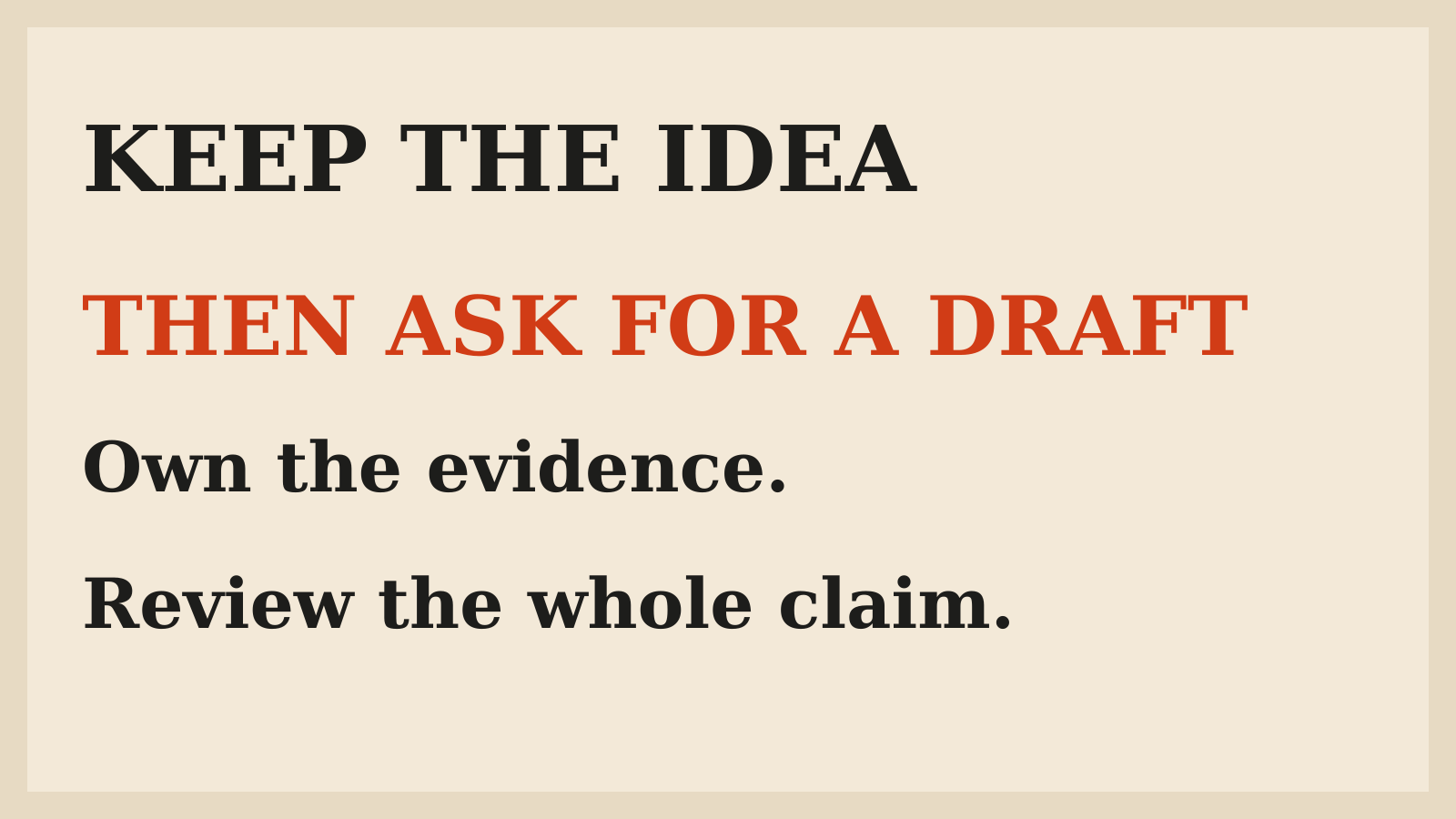
A new AI writing study suggests that keeping people involved in the idea and outline can matter more than making them approve an AI-written draft at the end. In this experiment, human-led early creativity and flexible collaboration produced better story quality and satisfaction than a workflow that mostly reduced the writer to confirming AI output[1].
That is a useful finding, but it is narrower than a claim that AI either destroys creativity or makes everyone a better writer. The participants were students, the task was short-story writing and the model was ChatGPT 3.5. The study did not evaluate every kind of professional writing or today's full set of models.
The paper by Kartik Hosanagar and Daehwan Ahn was published in PNAS Nexus on November 10, 2026. This article explains its design, the limits around its headline numbers and a practical workflow you could try. I did not reproduce the experiment or test the same writing task with newer models.
What the AI writing study compared
The experiment involved 285 students in a two-day classroom study. On the first day, they wrote a 1,000-word story without AI. On the second, they wrote a new story with ChatGPT 3.5 under one of three randomly assigned collaboration designs[1].
The designs separated who did the early creative work from who drafted and edited. That is more specific than a simple AI-versus-no-AI comparison. It lets the researchers examine different ways of dividing control within an AI-assisted task.
The paper reports 549 submitted stories and four evaluations per story, for 2,196 scores. Those are not 549 independent participants. Keep the units clear when reading summaries of the result.
It was also a deliberately constrained experiment. Some of the instructions were stricter than how people naturally use a chat assistant. That helps isolate a difference in collaboration design, but it limits how directly the findings can be transferred to everyday work.
The three collaboration designs
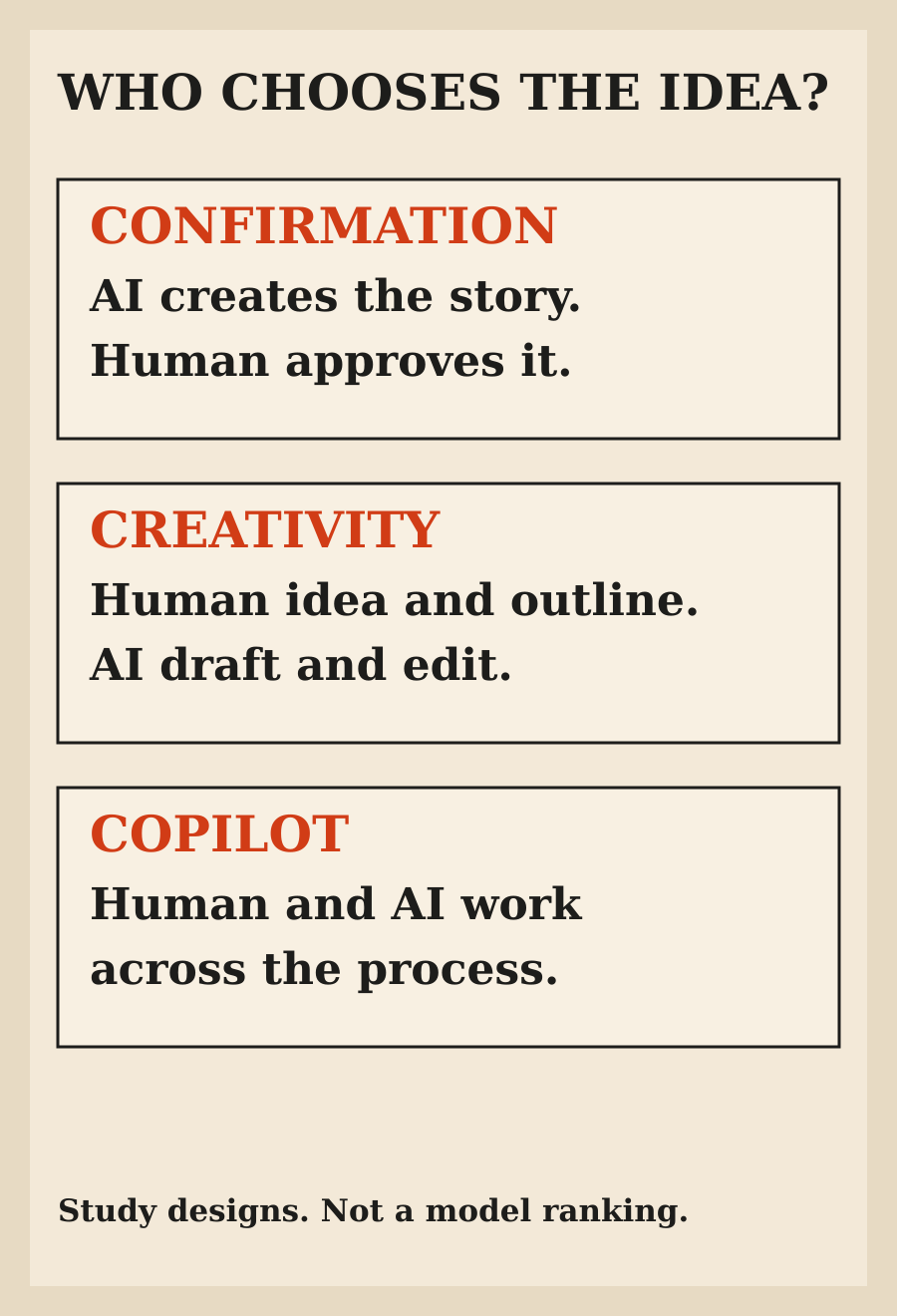
In Human Confirmation, the AI handled ideation, outlining, drafting and editing, while the human confirmed or rejected the output. Participants were instructed not to contribute additional ideas, making this a particularly strong version of an approval-only role[1].
In Human Creativity, people generated ideas, selected a concept and outlined the story without AI. The AI then handled drafting and editing, with the human confirming or rejecting those outputs.
In Copilot, people could work with AI across the process, from early ideas through editing. This gave participants more flexibility over when to ask for help.
These are experimental conditions, not product names or three universal writing methods. A real writing session may mix them. The useful question is whether the writer still makes meaningful decisions or mostly reacts to material the model has already chosen.
Quality depended on the division of work
The paper's central comparison is among the randomly assigned second-day designs. The two designs that retained human involvement in preproduction produced higher day-two story quality and satisfaction than Human Confirmation[1].
That does not establish that a human outline is always better than an AI outline. It shows that, within this setup, an approval-only role performed differently from having a more active part in the early decisions.
The distinction is useful for teams. A manager can ask people to review output while leaving them almost no influence over what the output is trying to do. Calling that human oversight does not make it equivalent to involving their judgment at the start.
The study supports taking collaboration design seriously. It does not justify ranking all writing tools or assuming that one prompt will reproduce the same result in marketing, legal drafting or software documentation.
Be careful with the 36.2 percent time figure
The paper reports that total completion time was 36.2 percent lower on day two than day one. However, every participant did the unaided task first and the AI-assisted task second. The authors explicitly say the within-person comparison cannot separate AI assistance from prior-task learning or other order effects[1].
There were no statistically significant differences in total completion time among the three AI collaboration groups. The way time was distributed across stages changed, but the experiment did not establish that one of those designs was the universal fastest method.
This is why I would not turn the number into an article promising that AI makes writers 36.2 percent more productive. That headline would convert a qualified descriptive comparison into a cleaner causal claim than the study supports.
If you want to estimate time savings in your own process, measure the full task, including planning, checking and revision. Use comparable work and preserve the conditions. Do not borrow a classroom percentage as the expected saving for your next client project.
Better individual output can still become more similar
The researchers also examined similarities among the stories. Within the AI-assisted conditions, Human Confirmation had the highest semantic similarity, while Human Creativity had the lowest. The designs that preserved early human involvement produced more varied stories relative to the approval-only design[1].
There is a second distinction: the number of genres within one story is not the same as diversity across the set of stories. A story can blend several genres while still resembling the other stories produced under the same approach.
The paper uses automated analyses, including embeddings and genre classification, alongside human ratings and participant surveys. These measures answer related but different questions. None should be treated as a complete definition of originality.
For practical writing, the warning is not that using AI makes every sentence identical. It is that delegating the premise as well as the prose may push many people toward similar starting points. Keeping your own observations and constraints can matter before word choice is even considered.
Satisfaction is part of the result
Participants in the approval-only condition described less ownership and pride, with some feeling removed from the story. The other AI collaboration designs reported higher satisfaction in the experiment[1]. The paper also analyzes reflections, so those experiences complement rather than replace the story ratings.
That matters when a team adopts a writing tool. A process can reduce drafting effort while making the writer feel less responsible for the work. If nobody can explain the decisions behind a piece, the final review becomes harder even when the text is fluent.
It does not mean every writer wants the same level of involvement at every stage. Someone preparing a routine status update may want a different division from someone developing an original essay. Choose the workflow for the job instead of forcing every task into maximum automation.
The useful management question is what human judgment you want to preserve. If the answer is voice, angle or domain expertise, make room for it before the assistant has committed the draft to a direction.
A practical workflow to try
Start with your own premise and the reason the reader should care. Write the observation, evidence or problem that made the piece worth doing. Decide what the article should not claim.
Then outline the argument before asking for a full draft. If you use AI during this stage, compare alternatives against your evidence rather than accepting the first coherent structure. This is a proposed workflow inspired by the study, not one the paper tested as a separate intervention.
Use the assistant for a bounded part of the work: reorganizing a section, proposing a clearer transition or drafting from an approved outline. Keep factual claims tied to sources and distinguish your experience from an example.
At review, ask whether the piece still expresses the premise you chose. A fluent draft can quietly replace a concrete observation with a generic claim. Fixing that is more important than cycling through synonyms to make the text sound less artificial.
Do not outsource the evidence check
A writing assistant can make a claim easier to read without making it true. Keep source verification separate from style improvement. Check dates, sample sizes, denominators and whether a result is causal, descriptive or only a vendor claim.
This article's time figure is an example of that distinction. A summary can repeat the correct number and still mislead if it drops the order-effect limitation. Press coverage is useful for orientation, but the paper is the stronger source for what its design supports[2].
The same habit appears in the guide to checking AI citations. Follow the source to the claim you are actually making, not merely to a page that mentions the topic.
For publication, keep a final review of what changed between source, outline and draft. If a statement became stronger in revision, either find the evidence for that stronger version or narrow it again.
What this study cannot settle
The sample was students in a particular educational setting, not a representative set of professional writers. The task was a 1,000-word story, not a long reporting project, a team campaign or an ongoing client relationship[1].
The model was ChatGPT 3.5. Newer models and interfaces may behave differently, but that possibility does not let us invent a result in either direction. A modern product demo is not a replication of this experiment.
The unaided task always came first, which limits causal interpretation of day-one versus day-two changes. The randomized comparisons among second-day collaboration designs are therefore more informative than a simple before-and-after AI productivity headline.
An earlier preprint exists, but this article uses the published journal version for the findings and caveats[3]. When sources change between versions, follow the version that supports the exact statement you publish.
My recommendation
Use AI to reduce work you can define without giving up the decisions that make the piece worth writing. Keep the idea, evidence and intended reader in view before asking for polished prose.
For a team, try a bounded comparison of collaboration methods and include quality, revision effort and ownership in the review. Do not judge the workflow only by how quickly a first draft appears. The agent final-state guide applies to writing too: a finished-looking artifact is not the same as an accepted result.
The study is a reason to design a better division of work, not a reason to stop using AI or to let it choose every part of the task.
FAQ
Did the study show that AI always reduces creativity?
No. It compared specific collaboration designs in a student short-story task. Outcomes differed according to how human creative control was retained.
Which model did the participants use?
The AI-assisted task used ChatGPT 3.5. The paper does not establish how every newer model would perform under the same conditions.
Can I expect a 36.2 percent time saving?
No. That is the study's descriptive day-one to day-two difference, and the design cannot separate AI help from learning or other order effects.
What was Human Confirmation?
It was the condition where AI handled ideation, outlining, drafting and editing while people confirmed or rejected output, under deliberately strict instructions.
Does this mean I should never brainstorm with AI?
No. Flexible collaboration was one of the tested designs. The useful lesson is to preserve meaningful judgment, not ban a particular stage of assistance.
Did you reproduce the experiment?
No. This article reviews the published paper and proposes practical checks. It does not report new writing tests or a modern-model comparison.