Kimi K3.1 Pro open weights: license and self-hosting
- Open Source
- Kimi
- Open weights
- Licensing
- Written by
- Bhargav Tibadiya
- Published
- Reading time
- 6 min read
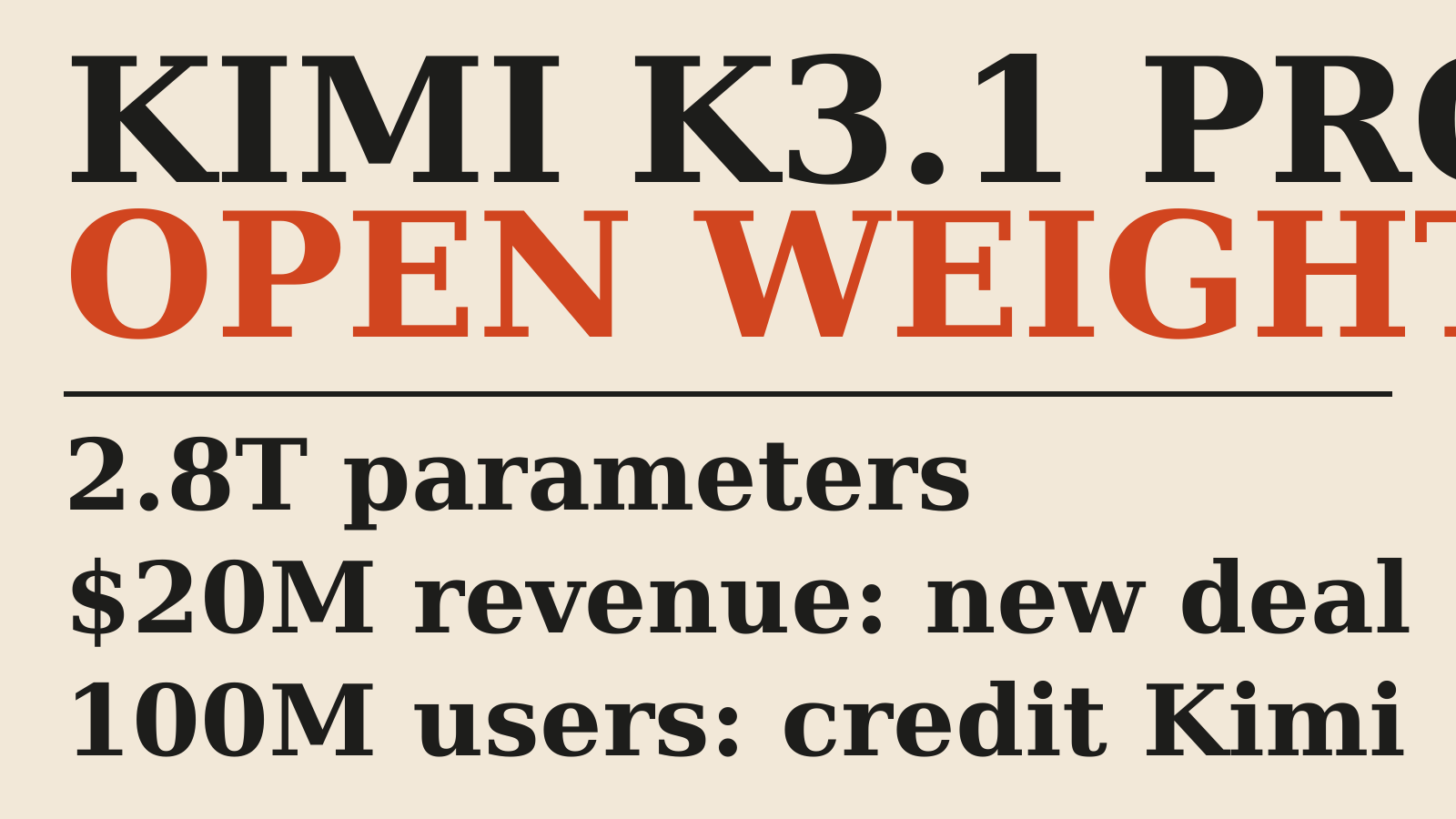
Yes, Kimi K3.1 Pro is open weights, and the license is short and permissive with two conditions that only bite at large scale. Moonshot AI publishes the weights on Hugging Face under its own Kimi K3.1 Pro License[1][2]. Most teams that use the model internally or in a normal product owe nothing extra. A company that resells model access, or ships to a very large audience, has to read the conditions.
This note summarizes the license text and the hosting figures from Moonshot and vLLM. I am not a lawyer, I did not run the model, and nothing here is legal advice. If a threshold applies to you, read the license yourself and ask counsel.
What does open weights mean here?
The model card calls it an open-weight, natively multimodal agentic model[1]. The weights are downloadable from Hugging Face. The license grants permission to use, copy, modify, merge, publish, distribute, sublicense and sell copies, and to run, deploy and fine-tune the software, including the weights, configuration files and inference and training code[2].
Open weights is not the same as open source in the strict sense. You get the model files and code under Moonshot's license, not a standard licence such as MIT or Apache. The text reads like MIT with added conditions, so check those conditions instead of assuming MIT terms.
What does the license actually require?
The license has five numbered terms[2]:
- Keep the copyright and permission notice in all copies, and comply with applicable laws.
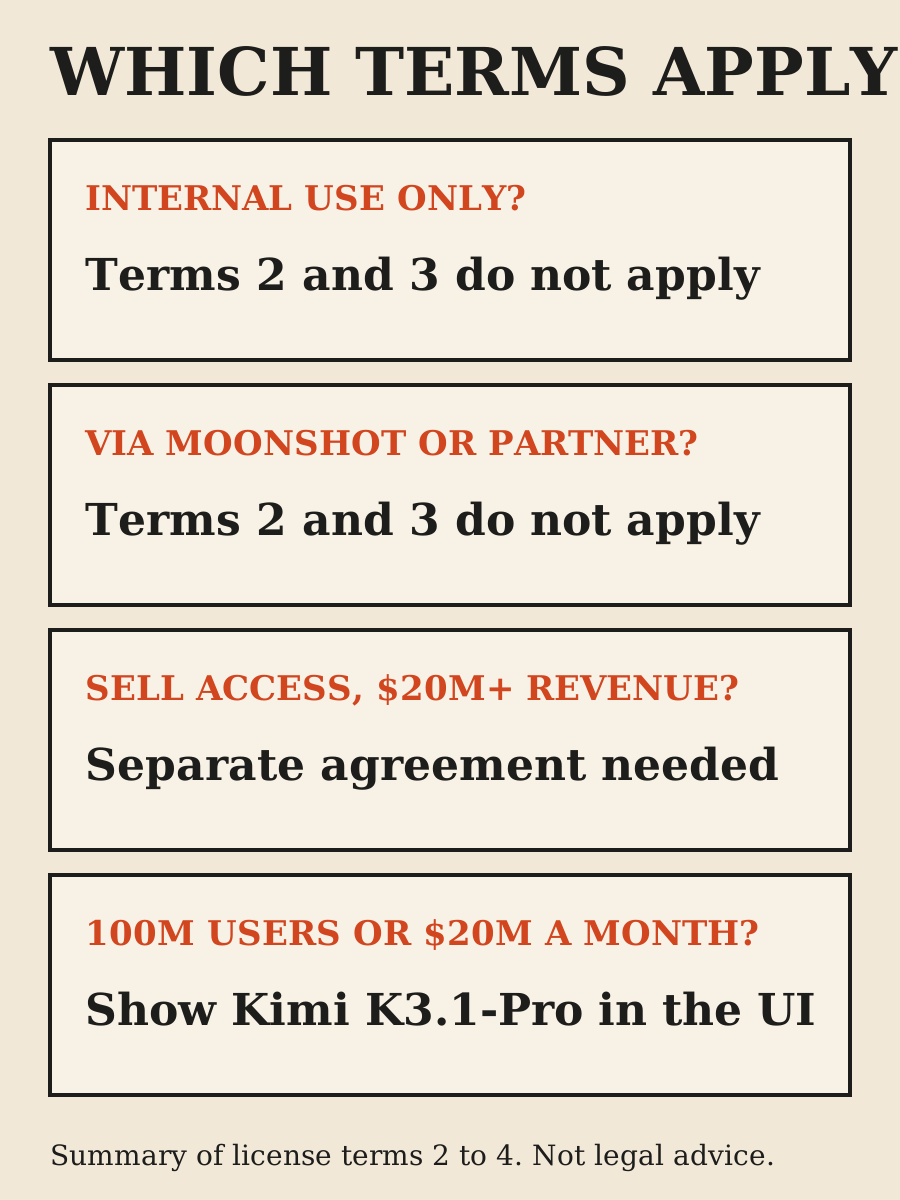
- If you or an affiliate runs a Model as a Service business and total revenue passes $20 million over any 12 months, you need a separate agreement with Moonshot before using the software or derivatives commercially.
- If your commercial product has more than 100 million monthly active users, or more than $20 million in monthly revenue, "Kimi K3.1-Pro" must be prominently displayed on its user interface.
- Terms 2 and 3 do not apply to internal use, or to use through Moonshot's official products or certified inference partners.
- The software is provided as is, with no warranty.
The license defines Model as a Service as giving a third party access to model inference or fine-tuning, for example through an API, in a way that lets them meaningfully control inputs, parameters or training data. It excludes end-user products with model features embedded in specific features or harnesses, and mere relaying of requests to models hosted by others[2].
Who is affected, in plain terms?
My reading of the text, not legal advice:
- A startup using the model inside its own app, or for internal tools, falls under the exemption for internal use or the carve-out for embedded features.
- A company selling API access to the model, or to fine-tuning of it, is the case the Model as a Service clause targets. Below $20 million in revenue the clause does not require an agreement. Above it, you need one.
- A consumer product with over 100 million monthly users, or over $20 million a month in revenue, has to show the "Kimi K3.1-Pro" name in its interface if it uses the model, unless the exemptions apply.
- Using the model through Moonshot's own API or a certified partner puts you outside terms 2 and 3.
The word "certified" is Moonshot's. The license does not list partners, so ask before you assume a host qualifies.
How big is it, and what does hosting take?
From the model card: 2.8 trillion total parameters, 104 billion activated per token, a Mixture-of-Experts design with 896 experts and 16 selected per token plus 2 shared, a context length of 1,048,576 tokens, and text and image input. Weights use MXFP4 with quantization-aware training[1].
vLLM's recipe for the model says the routed-expert weights are about 1.56 TB on disk and lists the MXFP4 variant at 1,874 GB. Its baseline is tensor parallel across 8 GPUs, on two GB300 trays or one B300 node, with other recipes for AMD MI355X and Google TPUs[3]. The recipe lists B300 GPUs at 268 GB each, so one 8-GPU node is about 2,144 GB. That is my arithmetic from its figures.
For comparison, an 8-GPU node of H100s with 80 GB each holds 640 GB, far under the 1,874 GB figure. The recipe says multi-node tensor parallelism requires InfiniBand[3], so a smaller-GPU setup means several networked nodes. I did not test any of these configurations. These are the vendor's recommended starting points, and throughput was not tuned, per the recipe[3].
The practical read: this is a cluster-scale deployment. A single workstation or a typical cloud GPU instance is not enough.
What does the API cost instead?
Kimi's pricing page lists kimi-k3.1-pro at $2.00 per million input tokens, $10.00 per million output tokens and $0.20 per million cached input tokens. Cache writes are $2.00 for a 5-minute TTL and $4.00 for 1 hour. A highspeed variant is double the input and output rate[4]. The page notes its rates were checked on October 24, 2026. I could not cross-check the table on the platform docs page, because its table did not render for me, so confirm before budgeting.
Here is an illustrative example, with made-up volumes. A workload of 10 million input tokens and 2 million output tokens a day costs 10 x $2 + 2 x $10 = $40 a day at those rates, before caching. Compare that with the cost of keeping an 8-GPU node running around the clock, which depends on what you pay for GPUs and which I have not priced.
The model card also says K3.1 Pro always reasons, with reasoning effort set to low, high or max and max as the default[1]. Reasoning tokens count as output, so effort level changes the bill.
What does Moonshot claim about performance?
The model card reports scores against Claude Fable 5.1, GPT-6 Astra, Claude Opus 5.5 and others. For example, Terminal-Bench 4.0 is 65.7 for Kimi K3.1 Pro against 66.4 for Claude Opus 5.5[1].
These are Moonshot's own reported numbers. The card's footnotes say some scores use different harnesses and that some comparison scores come from other vendors' reports and leaderboards. I did not reproduce any of them, so treat them as a starting point for your own test.
Should you self-host?
If you need data to stay on your own hardware, or you want to fine-tune, open weights are the reason to look at this. If you only want the model's output, the API at the rates above avoids a very large hardware bill. That is my judgment from the figures, not Moonshot's advice.
Before you commit, check the license thresholds against your business, test on your own tasks, and price the hardware you would actually run.
FAQ
Is Kimi K3.1 Pro open source?
It is open weights under Moonshot's own license. The text grants broad rights but adds conditions, so it is not a standard open source license.
Can I use Kimi K3.1 Pro commercially?
Yes, the license allows commercial use and sale. Conditions apply to Model as a Service businesses above $20 million revenue and to products above 100 million monthly users or $20 million monthly revenue.
Do I have to credit Kimi?
Only if your commercial product has more than 100 million monthly active users or more than $20 million in monthly revenue. Then "Kimi K3.1-Pro" must be shown on the interface.
Is internal use covered?
The conditions in terms 2 and 3 do not apply to internal use, defined as use that does not make the software, its outputs or its capabilities available to third parties.
How many parameters does Kimi K3.1 Pro have?
2.8 trillion total, with 104 billion activated per token, according to the model card.
What hardware do I need to run it?
vLLM's recipe uses 8 GPUs with tensor parallelism, such as one B300 node or two GB300 trays, for the MXFP4 checkpoint. It is not a single-GPU model.
How much does the Kimi K3.1 Pro API cost?
$2.00 per million input tokens, $10.00 per million output tokens and $0.20 per million cached input tokens, per Kimi's pricing page.
What is its context window?
1,048,576 tokens, per the model card.
Sources
Elsewhere on this site
The cheapest AI APIs comparison lists per-token prices across vendors, and the LLM API cost calculator lets you try your own volumes.




