Muse Ember: Can a Smaller AI Cut the Cost of Everyday Agent Work?
- AI Agents
- Muse Ember
- AI agents
- API costs
- Meta
- Written by
- Bhargav Tibadiya
- Published
- Reading time
- 6 min read
Meta's Muse Ember is aimed at the work agents repeat: reading documents, choosing a route, making tool calls and handling smaller coding tasks. Announced November 9, 2026, it is positioned as a cheaper execution model rather than the answer to every difficult reasoning problem[1].
My recommendation is to evaluate it on repeated, checkable work before using it for an entire open-ended project. A low price per call matters when the model reliably completes the step. It matters much less when failed steps create more retries or expensive mistakes.
This guide uses current announcement and reporting checked November 10. I have not run Muse Ember, measured its savings or tested it against another model. The cost examples and evaluation method below are illustrative, not observed account results.
What Ember is designed to do
Meta names tool calls, coding subtasks, routing, extraction and long-document parsing as intended uses. Its lineup positions Muse Wonder for harder problems, Muse Spark for coding and agent workflows, and Ember for repeatable execution at scale[1].
That gives a practical way to think about it. A larger model might decide how to approach a complex job, while a smaller one handles bounded steps with clear checks. This is a possible design choice, not evidence that splitting every workflow will improve it.
Independent launch reporting also describes Ember as a lightweight model for agent execution[2]. The important question is which steps in your product are predictable enough to evaluate separately.
Read the price with its prompt-length condition
Meta lists $0.10 per million input tokens, $0.004 per million cached input tokens and $0.50 per million output tokens for prompts up to 200,000 tokens. For longer prompts, the listed rates rise to $0.30 input, $0.012 cached input and $1.50 output per million tokens[1].
That condition is easy to miss in a headline. A model with a large context window does not necessarily charge the same rate at every prompt length. Count the actual input, not only the short instruction your user typed.
At the lower listed rates, one million uncached input tokens and 100,000 output tokens would total $0.10 plus $0.05, or $0.15. At the higher listed rates, those same token quantities would total $0.30 plus $0.15, or $0.45. These are simplified illustrations using the stated rates, not a forecast for an individual request or a complete agent bill.
Why one-third the cost needs context
Meta's launch compares intelligence scores with estimated cost per evaluation task, saying Ember matches Haiku's best score at about one-third the cost. It identifies the evaluation data, reasoning settings and list-pricing basis behind its comparisons, and says the Ember cost estimates use proposed pricing[1].
That is not a promise that replacing Haiku in your product cuts the monthly bill by two-thirds. Your prompts, acceptance criteria, tool behavior and failure costs can differ from the benchmark. Third-party reporting on the launch does not turn the vendor's selected comparison into your own measurement[2].
Use the claim to choose a trial, not to publish a savings forecast. Keep the exact task, settings and full usage record available so you can explain what changed.
Not every benchmark favors the same model
The announcement's table shows different strengths across evaluations. For example, its FrontierCode 2.0-AA result favors Haiku over Ember even though other listed results favor Ember[1].
That matters because a broad claim such as better value can hide a task-specific tradeoff. A model that is economical for extraction may not be the best fit for a difficult repository change. A higher aggregate score does not remove that distinction.
Meta also notes that Terminal-Bench results use different best-published harnesses for the models. This is not a clean experiment holding every surrounding tool constant. Choose the evaluation that resembles the work you actually need. Do not average away a failure on the one step that makes your product useful.
Count the whole task, including failures
Suppose an agent extracts invoice fields, checks them and records a result. The model call is only one cost. Document processing, external tools, retries, storage and review can all matter.
Track accepted outputs as the denominator. If the cheap model needs repeated corrections, calculate the total spent reaching a usable result rather than presenting its cheapest individual response as the cost of the task.
Also record mistakes that escape automated checks. A wrong amount saved to a system can cost more work than a failed request that is caught immediately. Low token prices do not make those downstream effects free.
Pick a first task with a visible finish
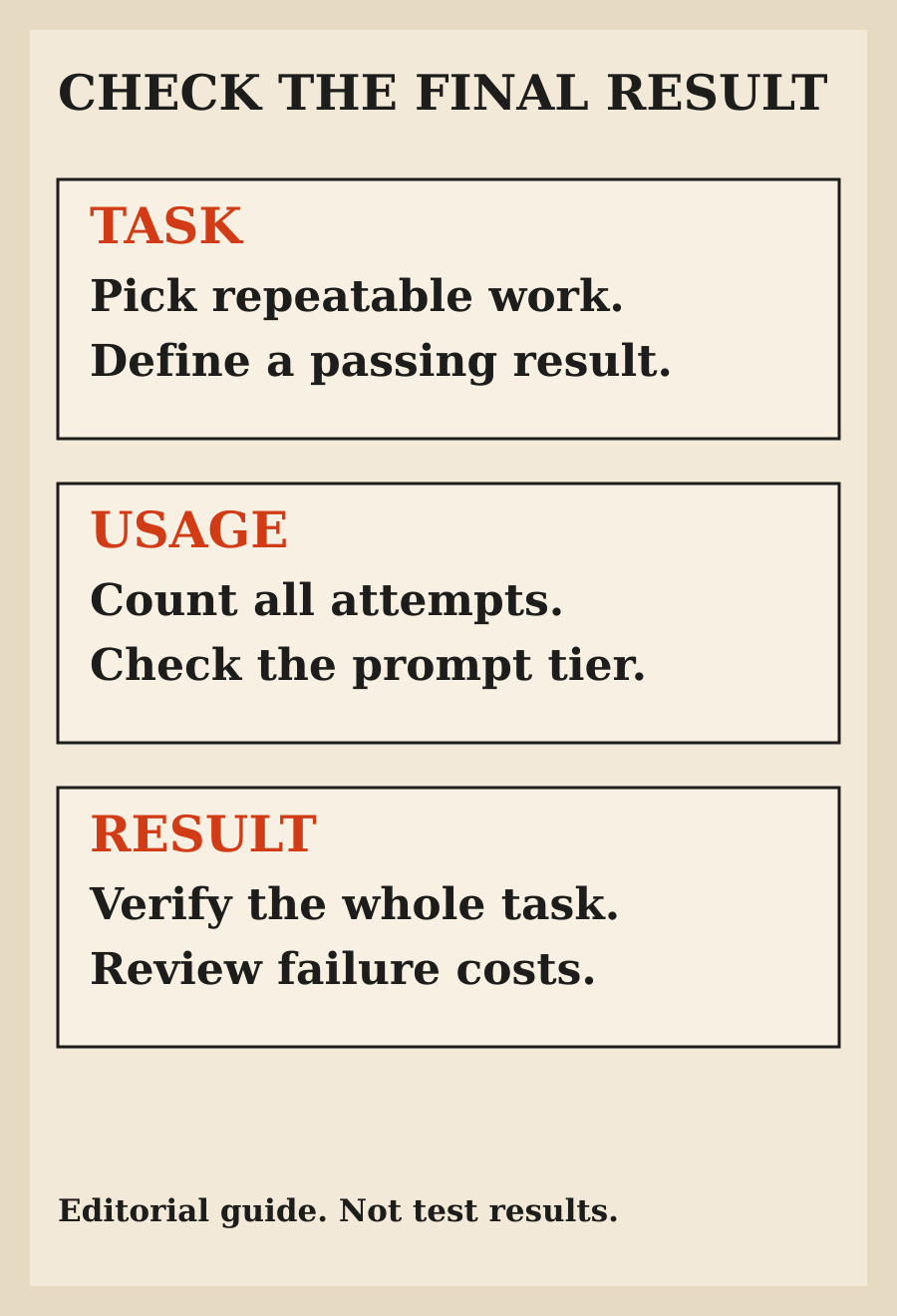
Start with something whose output can be checked against known data: routing a request into a fixed set of categories, extracting named fields or running a bounded code test. Include edge cases and ambiguous inputs, not only easy examples.
Keep the instructions and reference data constant across models. Record the selected reasoning setting, prompt length and whether caching applies. Otherwise a comparison can mostly measure differences in configuration.
Define what happens when the model is uncertain or wrong. A useful system can reject an answer, ask for review or route a hard case elsewhere. It should not silently turn a low-confidence response into an irreversible action.
Tool use still needs ordinary boundaries
Meta says it evaluated behavior involving sensitive information, user intent, hidden instructions and high-impact actions[1]. Those are vendor-reported safety checks, not proof that every integration will behave safely by default.
Give an agent only the access its task needs. Keep spending, destructive changes and external communications behind the appropriate approval and verification steps. A smaller execution model should not gain wider permissions merely because it is cheaper to call.
For production, test the tool boundary as well as the answer. Confirm that rejected inputs do not still trigger actions and that a failed tool call is reported as a failure rather than a completed task.
Availability does not mean open weights
Meta says Ember is available through Muse Code and the Meta Model API as `muse-ember-1.0`, with support for the Responses API. The announcement lists a one-million-token context window and up to 512,000 output tokens[1].
Those facts describe the offered service. They do not establish an open-weight release, a self-hosting right or identical availability in every account. Do not infer those from Meta's history with other models.
Before using private data, check the terms and data handling for the actual service and account you select. Before relying on a cloud route, verify the model and region there rather than assuming every channel exposes the same settings and price.
My take
Muse Ember is interesting because repeated small steps can dominate an agent product's volume. Making those steps less expensive could improve the economics of a useful workflow.
But the target is lower cost per accepted result, not the lowest rate in a model menu. Run a small comparison, include retries and review, inspect the failures and retain a route for harder cases. Keep the cheaper model only where the actual finished work supports the decision.
FAQ
What is Muse Ember?
It is Meta's smaller model aimed at repeatable agent work such as tool calls, routing, extraction and coding subtasks, announced November 9, 2026.
What does Muse Ember cost?
Meta lists $0.10 input and $0.50 output per million tokens for prompts up to 200K tokens, plus a lower cached-input rate. Longer prompts have higher listed rates. Check the actual account and route before relying on a bill estimate.
Does the one-third-cost claim apply to my product?
Not automatically. It refers to the launch's evaluation comparison. Measure your own accepted tasks, retries, tools and review work.
Is it better than every larger model?
No such conclusion follows here. The launch results vary by evaluation, and task-specific reliability matters more than a general ranking.
Can I self-host it?
The cited announcement establishes API and product availability, not an open-weight release or self-hosting permission.
Did you benchmark Muse Ember?
No. This is a source-based explanation and proposed cost-evaluation method, not a report of measured savings.
Sources
Elsewhere on this site
Claude Fable 5.2: what changed and when to use it explains a different model tier and why task fit still matters.






