Your Next Customer May Buy Through an AI Agent. Is Your Store Ready?
- AI Coding Tools
- AI agents
- Ecommerce
- Small business
- Agentic commerce
- Written by
- Bhargav Tibadiya
- Published
- Reading time
- 7 min read
An AI shopping agent is useful to a store only if it can move a customer from a suitable product to a correct, supportable order. Being mentioned in an AI answer is one step. Accurate stock, checkout, fulfillment and returns are the rest of the business.
The current hook is firmly's November 5 announcement of Ask Agent, a conversational shopping experience for merchant sites. The company describes natural-language discovery using a real-time catalog, in-chat checkout and customer support. It also announced new funding for its commerce infrastructure[1].
That is evidence of a product direction, not proof that an AI widget will improve your conversion rate. This is a documentation-based readiness guide checked November 9, 2026. I did not connect a store, place an agent order or measure sales lift.
Discovery and checkout solve different problems
A shopper might ask an assistant which jacket suits a rainy commute, compare several options and then leave the conversation to buy. Another experience might carry the purchase into a connected checkout. The two paths need different information and different integrations.
For discovery, the assistant needs reliable facts about the product and who it suits. For a transaction, the system also needs current price, availability, shipping and an authorized way to create the order. A compelling description does not settle those operational details.
Before evaluating a vendor, draw the journey you want. Are you trying to help visitors on your own site, appear in another assistant's recommendations, or accept orders through a new channel? Do not buy one capability while expecting all three.
Make the product facts agree
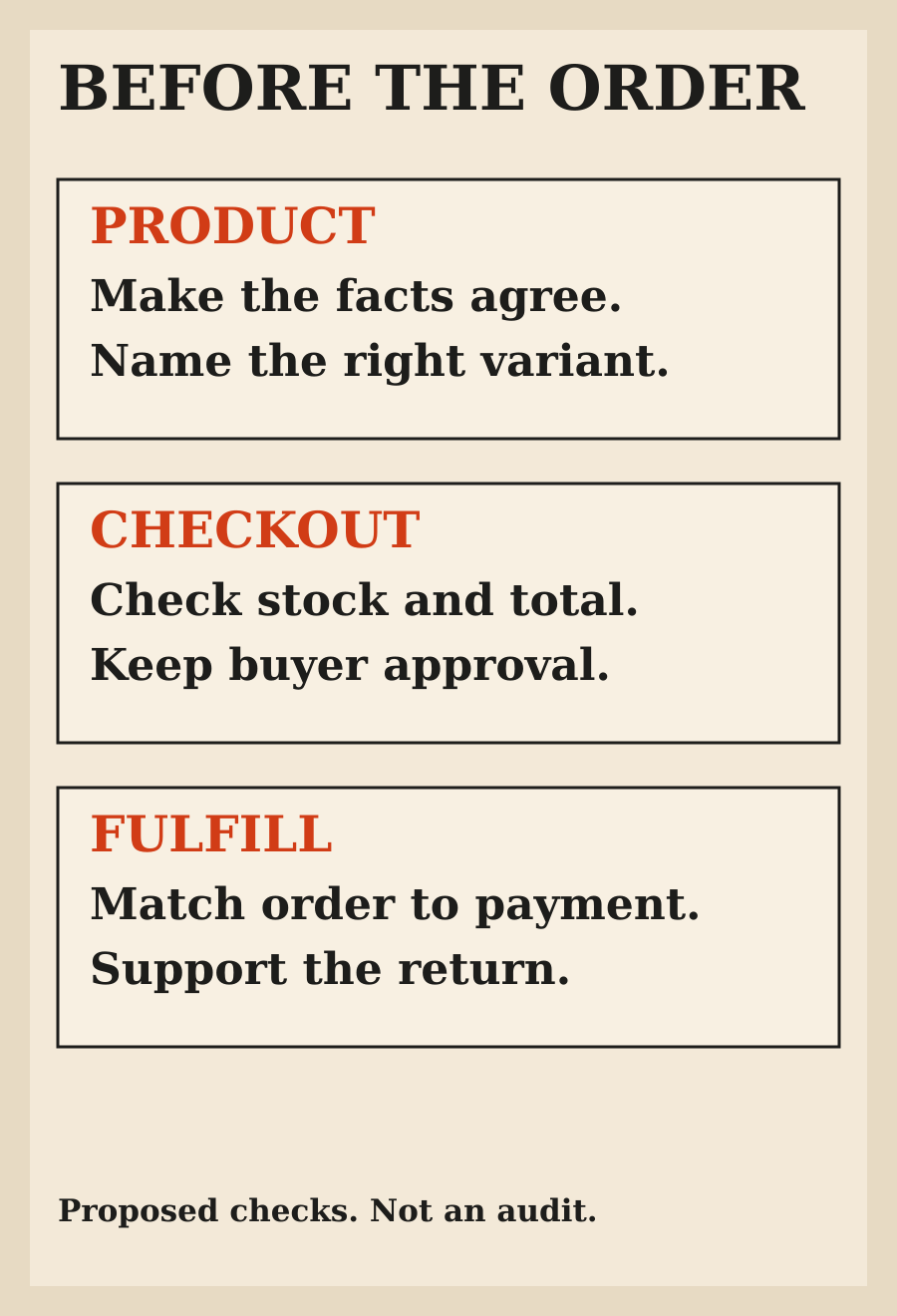
Start with your catalog rather than a new landing page about AI. Compare the product page, structured data, feed, support article and promotional copy. Look for contradictions in size, material, compatibility, included accessories and warranty terms.
In a November 2 Talk Commerce interview, Comergent AI founder Praneet Chandra described product information as the first problem to fix. His example was AI-written content claiming one thread count while a product page claimed another[2]. It is an industry participant's advice, not a controlled ranking experiment, but the underlying review is practical.
Keep a named source for each important specification. If your own systems disagree, an agent has no dependable answer to pass on to the customer. More generated content can multiply the inconsistency rather than repair it.
Write for a purchase decision
A product description should explain what the item is, who it fits and what would make it the wrong choice. That is useful to a person and to a system helping that person compare options.
For a software product, name supported environments and plan limits. For a physical product, name dimensions, variants, materials and compatibility where they matter. Avoid a page full of impressive adjectives that never answers whether the item fits the customer's use.
Keep claims supportable. An assistant repeating an unsupported promise about safety, performance or compatibility does not make it your assistant's problem. The customer still bought from your business.
Price and stock need a current source
A stale answer can become a real order problem. Decide which system owns price and inventory, how updates reach a new channel and what happens when stock changes during checkout.
firmly says Ask Agent recommends from the merchant's real-time catalog, pricing and inventory[1]. That is a vendor capability claim to verify during integration. Ask how variants, promotions, reserved stock and shipping restrictions behave in your actual catalog.
Test an item with limited stock and a variant that is unavailable. Check the customer's final confirmation, not only the assistant's suggestion. A flow that can suggest a size should also be able to say clearly when that size cannot be bought.
Keep the buyer's approval attached to the order
A recommendation is not permission to purchase. The customer needs a clear point at which the actual item, variant, quantity, total and delivery terms are confirmed.
Look carefully at substitutions. If the chosen item is unavailable, a similar product is a new choice, not an invisible implementation detail. The same applies when shipping or a discount changes the final price.
Ask vendors to demonstrate those cases with test data. Your review should establish what the buyer sees and agrees to, not only whether the assistant can complete the fastest possible checkout. This is a proposed evaluation approach, not a claim about a specific platform's approval behavior.
Know who is responsible after payment
Before adding a channel, identify the merchant of record, payment provider, order system and support owner. A smooth conversation can hide a confusing division of responsibility.
firmly says its Connect infrastructure lets merchants retain their role as merchant of record, customer relationships, transaction data and payment provider[1]. Those are important points to confirm in the terms and actual integration, rather than assuming every agent-commerce product follows that model.
Ask where the order number comes from, how the customer gets a receipt and who can issue a refund. If your support team cannot find the transaction in the normal system, the new channel has created another queue to manage.
Reconcile orders instead of trusting a success message
Trace a test purchase across the customer confirmation, payment record, inventory change and fulfillment queue. Each should refer to the same order and the same amount.
Check a delayed payment confirmation, a repeated click and an interrupted session. A retry should not create a second shipment because the first response was slow. A successful payment should not leave a customer with no recognizable order.
These are ordinary commerce checks applied to a new interface. Calling the interface an agent does not remove the need to understand the final state of the systems that charge and deliver.
Returns are part of the product data
Publish a return policy that a customer can understand before paying. Make exceptions visible for final-sale items, subscriptions, digital products or personalized goods if those apply to your store.
Then check the operational route. Can support identify the order, start the return, reconcile the refund and update whatever status the new channel shows? Does the customer know where to ask when a delivery is late?
Do not let a generated response invent a more generous policy than the business provides. The assistant's wording should follow the current policy, and an uncertain case should reach someone who can decide it.
Treat sales claims as a hypothesis
firmly's announcement reports early conversion and average-order-value improvements. Those figures come from the company, not an independent study of your store[1].
A useful pilot measures completed orders, refund and support effort, errors and customer understanding alongside conversion. More orders are not automatically better if the channel causes wrong variants, avoidable returns or expensive manual corrections.
Write down the baseline before enabling the experiment. Separate the effect of a new interface from promotions, seasonal traffic and a changed product mix. Without that context, an appealing number can tell you less than it appears to.
Ask about the integration, not only the demo
An agent-commerce demo often shows one product and one successful path. Your catalog may include bundles, subscriptions, restricted destinations, local pickup or business pricing. Name those cases early.
Ask which systems are supported, which data is stored by the vendor and what happens if you disconnect. Confirm fees, settlement, access controls and support responsibilities in current vendor terms before committing. This article does not provide a verified price comparison of platforms.
Do not assume that connecting a provider guarantees placement inside every major assistant. Website shopping, catalog syndication and assistant-specific distribution are separate capabilities. Check the particular channel you want to reach.
Start with a bounded pilot
Choose a small catalog segment with clear product facts, uncomplicated delivery and a support team that can see every order. Keep a way to pause the channel without taking down the rest of the store.
Review real questions as well as transactions. If people repeatedly ask whether an accessory is included, fix the underlying catalog information instead of teaching the chatbot to improvise around it.
The opportunity is not to fill the web with more AI copy. It is to make your business easier to understand and safer to buy from, wherever the conversation starts. A store prepared for that is in a better position to evaluate new shopping channels without confusing a launch announcement with a guaranteed sales result.
FAQ
What is agentic commerce?
It is a broad term for shopping workflows in which an AI system helps with discovery, decisions or transactions. The exact capabilities depend on the product and integration, so ask which parts of the customer journey are actually supported.
Is an AI recommendation the same as an order?
No. A recommendation does not establish current stock, buyer approval, payment or fulfillment. A supported checkout and confirmed order are separate requirements.
Should I rewrite every product page for AI?
Start by fixing missing and contradictory facts. Clear descriptions, accurate variants, current prices and understandable policies are more useful than adding unverified claims or large amounts of generated copy.
Will adding a shopping agent increase conversion?
That has to be measured for your own store. Vendor case studies can suggest possibilities, but they do not establish the result for another catalog, audience or checkout.
What should a small store test first?
Use a limited set of straightforward products. Check discovery, stock changes, buyer confirmation, payment, fulfillment and returns before widening the catalog or audience.
Did you test an agentic-commerce platform for this article?
No. This is a sourced readiness guide with proposed checks. It is not a platform benchmark, completed integration or claim of increased sales.
Sources
Elsewhere on this site
AI App Launch Readiness covers customer access, payment checks and recovery before a new app takes money. AI Agents vs Workflows explains when a predictable process should stay predictable.